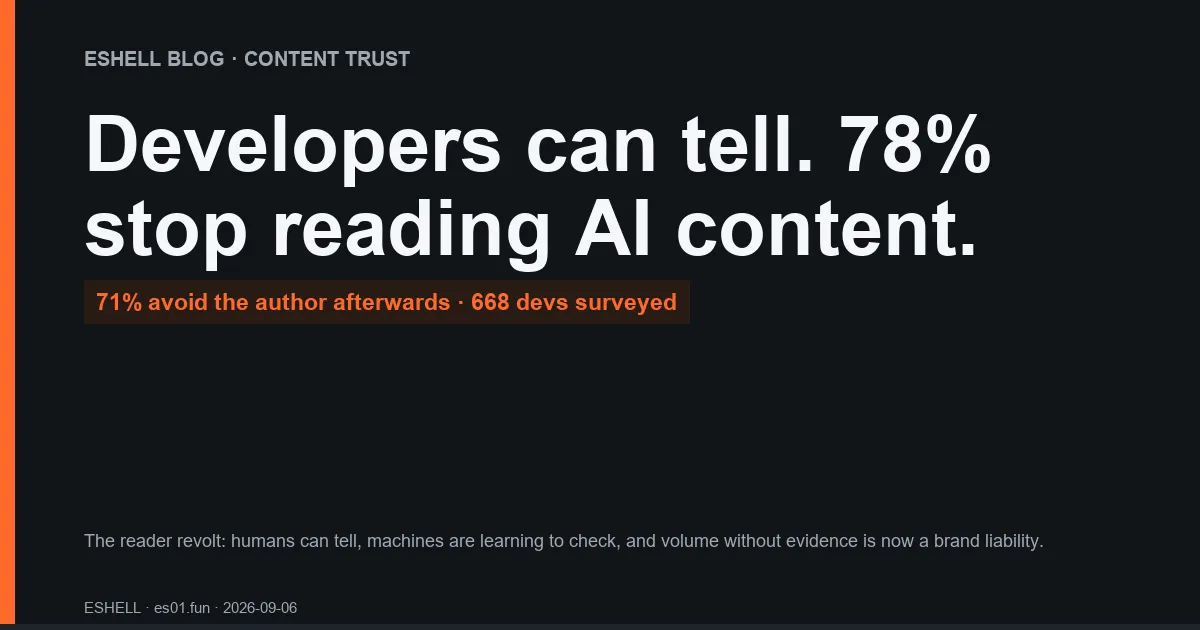
Developers Can Tell: 78% Stop Reading AI Content
78% of developers stop reading the moment they detect AI-written content, and 71% avoid that author later. What the reader revolt means for software marketing.
Developers Can Tell. 78% Stop Reading the Moment They Detect AI Content.#
A survey of 668 developers found that 78% stop reading immediately when they detect an article was written by an AI, 71% say they will avoid that author in the future, and 98% would rather read an author’s own imperfectly written piece than an LLM-polished one (source: Cynthia Dunlop, “Dev reaction to AI blog posts,” writethatblog.substack.com, survey of 668 developers; survey highlighted in Bryan Cantrill’s essay “The Revolt of the Reader,” bcantrill.dtrace.org, September 5, 2026). That essay hit the top of Hacker News within a day, carrying 362 points and 150 comments when we checked it on September 6, 2026 (news.ycombinator.com, item 49580939).
Here is the conclusion up front: if your target buyer is a developer, AI-written content is no longer just low-quality content. It is content that actively repels the person you are trying to reach, and the tools to detect it are getting good enough that “they will never know” is no longer a workable assumption. The teams that keep winning in 2026 are the ones that treat a verifiable evidence chain and a real human voice as the product, not as a production shortcut to be optimized away. Volume without evidence is becoming a brand liability with a machine-readable signature.
The Numbers Behind the Revolt#
Cynthia Dunlop is a technical writer who asked developers directly what they do when they suspect a post was AI-generated. The survey reached 668 developers, and the answers were brutal:
- **78% stop reading immediately when they detect an LLM wrote the piece.
- 71% avoid that author in the future. Not just that post, that author.
- 98% prefer the author’s own imperfectly written version** over an AI-polished one.
Read those three numbers together and the strategic implication is uncomfortable: the audience you most want to reach, the developers who evaluate and buy your software, is the audience most trained to spot synthetic prose. They are not asking for better grammar. They are asking for proof that a human actually worked through the ideas.
Cantrill, who writes about systems software and whose essay triggered this week’s Hacker News thread, frames it as a broken social contract: when a piece is written by an LLM, readers no longer know what is real and what is not, and they refuse to do the labor of parsing a sentence the writer did not work to create (bcantrill.dtrace.org, September 2026). His metaphor is the open fly: to a broad reader, the hand of the LLM is so obvious it is embarrassing.
Why the Tell Is Unmistakable#
If you publish software content, you have probably read a hundred posts this year that all sound like the same writer. That is not an accident. LLM prose has a consistent structural fingerprint: every section gets a transition, every claim gets a hedge, every list ends with a summary sentence that restates the list. Readers who consume a lot of technical writing notice this instantly, even when they cannot articulate what tipped them off.
The survey data says the reaction is not mild annoyance. Cantrill describes readers pulling an “LLM-triggered ejection handle,” bailing out mid-sentence in an act of self-preservation (bcantrill.dtrace.org, September 2026). He even fantasizes, only half joking, about sentencing authors to read their own AI-generated pieces aloud, certain they would not survive the slop.
None of this is about perfection. The 98% figure is the telling one: developers do not want flawless prose. They want writing that shows a mind at work, with the visible friction of actual thought. A post with a wrong number that a reader can trace and a real author who corrects it builds more trust than a perfectly smooth piece that could have been generated in a single prompt.
Machines Are Learning to See It Too#
For a long time, the practical defense for publishing AI content was “humans cannot prove it.” That defense is eroding on two fronts at once.
First, regulation. Under the EU AI Act, rules that took effect August 2, 2026 require labels on synthetic text, images, audio, and video that look authentic, with companies like Anthropic publicly committing to compliance and describing watermarking mechanisms that machines can recognize (source: The Guardian, “AI labels to be compulsory on authentic-looking content under EU rules,” theguardian.com, July 2026; and Anthropic’s published explanation of how Claude marks AI-generated content, support.claude.com). We covered this shift in detail in our earlier post on AI watermarks, and the direction has not changed: the “looks real” era of synthetic content is ending.
Second, detection quality. Cantrill reports that Pangram Labs’ Pangram 3 model was already a leap over earlier detectors, and that Pangram 4, released in 2026, is a step-function improvement with an astonishingly low false-positive rate in his months of testing (source: Pangram Labs, “Pangram 4” technical announcement, pangram.com; evaluation reported in bcantrill.dtrace.org, September 2026). Low false-positive rates are the key metric here: a detector that cries wolf is useless, but a detector that only flags text it is confident about becomes usable as a screening tool at scale.
Put the two fronts together and the strategic picture changes. Content that is prompt-and-publish AI output is now the most exposed category in marketing: humans can tell (78% ejection rate), and machines are increasingly able to confirm it.
The Spam Lesson: What Happens When a Label Sticks#
Cantrill’s essay draws the analogy that matters most for marketers: email spam. In the early 2000s, people feared spam would kill email. What actually happened is that filtering improved until the economics of spam collapsed, and then something more important shifted: the consequences of being labeled as spam became severe. Today, legitimate businesses are extremely careful about bulk email because being labeled as spam can effectively destroy a domain and tarnish a brand (bcantrill.dtrace.org, September 2026).
The same arc is now visible in content. When detection was unreliable, publishing low-effort synthetic content had no reputational cost. As detection improves, the label starts to stick, and the label is worse than the individual post. A reader who identifies one AI-written article from your company does not just skip that article. Per the survey, they avoid the author. For a software company, the author is the brand.
There is a second-order effect worth naming: the developers who react this way are exactly the tastemakers. Dunlop’s respondents are active readers on social media, the people most likely to repost writing they like and most likely to tell their team what to read (writethatblog.substack.com, 2026). Losing them is not losing one reader. It is losing the distribution node.
What This Means for Software Content Programs#
If you sell to developers, or to the technical buyers inside software companies, this data should change three decisions.
Decision one: how much content you publish. The volume play was always a bet that marginal content costs nothing. When marginal content actively repels your core audience, the calculus flips: a smaller number of posts that each carry a human voice and a verifiable evidence chain will outperform a large volume of polished nothing. This matches what we see in the agency market, where “unlimited content” retainers are usually the ones without sourceable data, no keyword logic, and no revision discipline (see our pricing guide to marketing agencies for software companies for the full red-flag list).
Decision two: where the numbers come from. Every data point in your content should be traceable to a named source, and every claim about your own product should be something you can demonstrate. This is a rule we enforce internally at EShell: no number without a source, no source without a date. It is slower than prompting, and it is exactly the friction that makes the result worth reading. When AI search engines decide what to cite, verifiable facts are the only facts that travel, and the same property is what keeps human readers from hitting the ejection handle.
Decision three: what AI is for in your workflow. The reader revolt is not an argument against using AI. We use it constantly for research, for structuring outlines, for checking our own blind spots. The line that matters is authorship: if a human did not work through the idea, the piece should not carry the human’s name. Cantrill’s rule is the cleanest version: to use an LLM to write is to void the social contract between writer and reader, because the reader is expected to work at understanding a sentence the writer did not work to create (bcantrill.dtrace.org, September 2026). Keep AI on the research side of that line.
How We Write So Developers Keep Reading#
Since we are making claims about a standard, here is the standard, applied to this very post:
- Every statistic in this article carries a named source in the same sentence, with the domain and date. If a number does not have a source, it does not go in.
- The post is written by a named human on our team who has run developer marketing programs, then edited by other humans. AI was used for research and for stress-testing the argument, not for authorship.
- Claims about our own process are limited to what we actually do, which readers can verify by looking at anything we publish.
- We would rather publish a post with an imperfect sentence and a real point than a smooth post that could have come from anywhere.
This is more expensive per post than the alternative. We think the survey data says it is the only economically rational option for anyone whose audience includes developers.
FAQ#
Can readers really tell the difference between AI and human writing? In the population that matters for software companies, yes. In Cynthia Dunlop’s survey of 668 developers, 78% said they stop reading immediately when they detect an LLM wrote a piece, and 71% said they would avoid that author in the future (writethatblog.substack.com). Technical readers consume enormous volumes of writing and are highly trained at pattern recognition.
Does this mean I cannot use AI in my content at all? No. The distinction is between using AI as a tool and letting AI be the author. Using AI for research, outlining, editing, and pressure-testing arguments is compatible with a human voice. Publishing text that no human worked through, under a human byline, is what triggers the reaction the survey documents.
Will detection tools actually matter for marketing content? Increasingly. EU labeling rules for authentic-looking synthetic content took effect in August 2026 (The Guardian, July 2026), major labs have published watermarking mechanisms (support.claude.com), and detector quality has improved sharply, with Pangram 4 described as a step-function improvement over earlier models (pangram.com). Detection does not need to be perfect to change the economics; it needs to be reliable enough that the label sticks.
Which content is at highest risk? Prompt-and-publish volume content: listicles and thought-leadership posts generated without a human working through the argument, without personal experience, and without sourceable data. The content type with the lowest risk is the one built on evidence: named sources, verifiable numbers, and the visible friction of real experience.
What should we change this week? Audit your last ten posts with a simple test: for every number, can you point to the source? For every post, can you name the human who worked through the idea? Start deleting or rewriting the ones that fail. Then slow down: publish fewer posts, each with a real author and a traceable evidence chain, and watch what happens to engagement from technical readers.
Bottom Line#
The revolt of the reader is not a theory. It is a survey of 668 developers, an essay that climbed to the top of Hacker News in a day, and a detection industry that just got a step-function better. For software companies, the message is unusually direct: the audience you are trying to reach can tell, they care, and they remember the author. Content that treats trust as an afterthought is not neutral anymore. It is actively working against you, and soon the machines will be able to prove what the humans already knew.
The teams that win the next phase of developer marketing will not be the ones with the best prompts. They will be the ones whose content carries receipts: a human who worked through the idea, and sources that check out.
Sources: Cynthia Dunlop, “Dev reaction to AI blog posts” (writethatblog.substack.com, survey of 668 developers, 2026); Bryan Cantrill, “The Revolt of the Reader” (bcantrill.dtrace.org, September 5, 2026); Hacker News discussion (news.ycombinator.com/item?id=49580939, 362 points, September 6, 2026); The Guardian, “AI labels to be compulsory on authentic-looking content under EU rules” (theguardian.com, July 2026); Anthropic, “How Claude marks AI-generated content” (support.claude.com, 2026); Pangram Labs, Pangram 4 announcement (pangram.com, 2026); company data (EShell editorial standard: every number sourced, human authorship, verified at blog.es01.fun).
Related reading: AI Watermarks Just Ended Undetectable AI Content ↗ · Marketing Agencies for Software Companies: 2026 Pricing ↗ · Our services ↗