Backlinks Just Became the Weakest Signal for Getting Cited by AI#
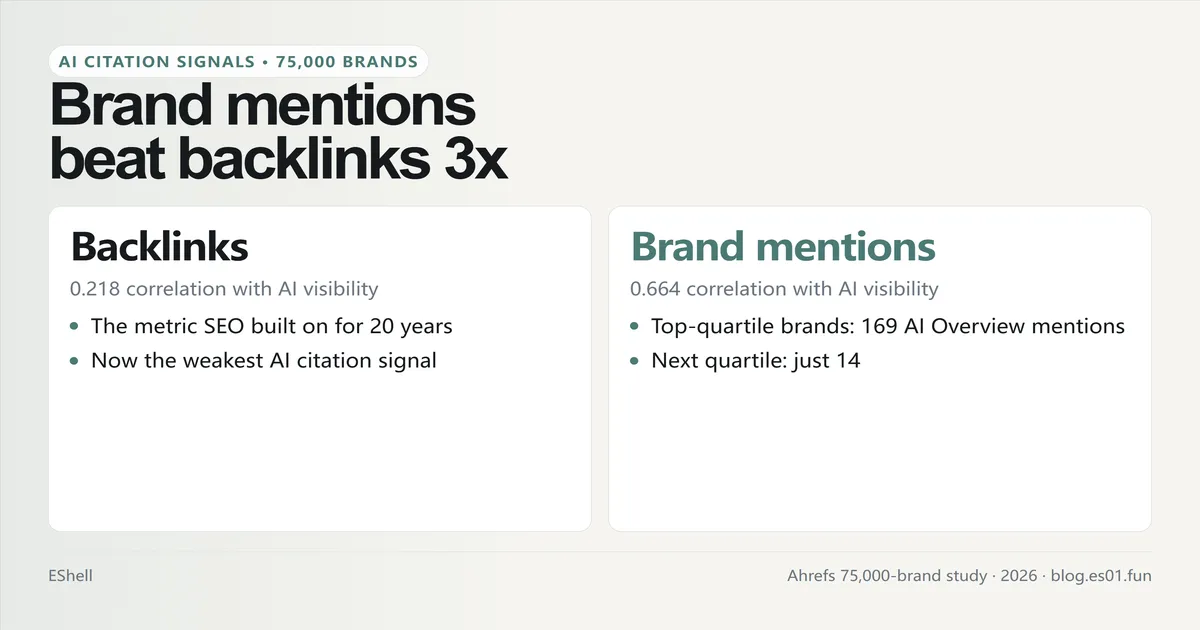
Branded web mentions correlate about 3x more strongly with AI visibility than backlinks do, according to Ahrefs’ analysis of 75,000 brands: branded web mentions sit at 0.664, branded anchor text at 0.527, and branded search volume at 0.392, while the number of backlinks correlates at just 0.218 (ahrefs.com/blog/ai-overview-brand-correlation/, 2026). The gap at the extremes is even wider: the top 25% of brands by mention volume average 169 AI Overview mentions, versus just 14 for the next quartile, more than a tenfold difference (Ahrefs data, summarized at digitalapplied.com/blog/ai-search-citation-ranking-factors-2026-data-study/).
The short version: the metric SEO teams spent two decades optimizing is now the weakest predictor of whether AI answers cite you. Link volume correlates at 0.218 with AI visibility, while off-site brand signals correlate 2-3x higher, and independent studies keep reproducing the same order: mentions beat links, brand search volume beats domain authority, and freshness beats both. If your 2026 plan still leads with link acquisition, the data says you are funding the least effective lever. Here is the evidence, the mechanism, and the budget shift it implies.
The Numbers That Reorder the Priority List#
Ahrefs studied 75,000 brands, filtering for domains with a Domain Rating above 40 and their highest-volume keywords with at least 800 monthly searches, then measured which factors correlate with appearing in Google AI Overviews (ahrefs.com/blog/ai-overview-brand-correlation/, 2026). The resulting order is unambiguous:
- Branded web mentions: 0.664 correlation
- Branded anchor text: 0.527
- Branded search volume: 0.392
- Domain Rating: 0.326
- Number of backlinks: 0.218
The finding reproduces across datasets. ConvertMate’s study of 80 million citations found brand search volume to be the strongest single predictor of LLM citation frequency, at 0.334 correlation (ConvertMate AI Visibility Study, 2026). Wellows reports that domain authority’s correlation with AI citation likelihood has fallen to roughly 0.18, down from 0.43 before 2024 (wellows.com/blog/llm-citation-trends-for-ai-search/, 2026). The direction of travel is consistent: the signals SEO built on are decaying, and brand signals are replacing them.
Why AI Engines Cite Brands, Not Links#
The mechanism is different from Google’s PageRank story. Link graphs were Google’s proxy for reputation because links were expensive to earn and hard to fake at scale. AI engines do not need that proxy. They were trained on the entire web and can observe, statistically, which entities are searched for, mentioned, quoted, and discussed across contexts. When a model generates an answer, it reaches for entities that appear consistently across its training distribution, and brand search volume is a direct measure of that distribution (Ahrefs, 2026).
An arXiv study of 100,000+ prompt responses across 100+ brands (March to May 2026) quantified the same pattern as a three-tier ladder: global household names appear in about 73% of relevant AI answers, established mid-market brands in about 44%, and niche brands in only about 11% (study summarized at machinerelations.ai/research/ai-search-citation-factors-2026/). Each tier of brand stature is worth roughly 30 points of citation presence, and no amount of link building moves a brand between tiers. Only earned attention does.
What This Means for SaaS Marketing Budgets#
For a software company the reallocation is uncomfortable because link building has clean reporting and brand building does not. But the data is blunt about relative leverage:
- Digital PR and earned mentions now outrank link acquisition as AI-visibility levers. A mention on a relevant publication, podcast, or directory feeds the branded-mentions signal directly (0.664), while the link inside that mention barely moves the AI needle on its own (0.218).
- Community presence compounds differently. Genuine participation in developer communities produces the mentions and entity reinforcement that AI engines weight, which is one reason community-built brands keep appearing in answers without chasing links.
- Review platforms and comparison listings behave like mention sources now. G2-style coverage correlates with AI visibility through the same brand-signal channel.
The nuance that keeps link building honest: links are not worthless, they are just no longer the primary AI lever. A link from a relevant site still brings referral traffic and still feeds the mention signal if it uses your brand name in context. The mistake is treating raw link count as the KPI for AI visibility, because the correlation data says it is the weakest of the traditional signals.
The Winner-Takes-Most Shape of AI Visibility#
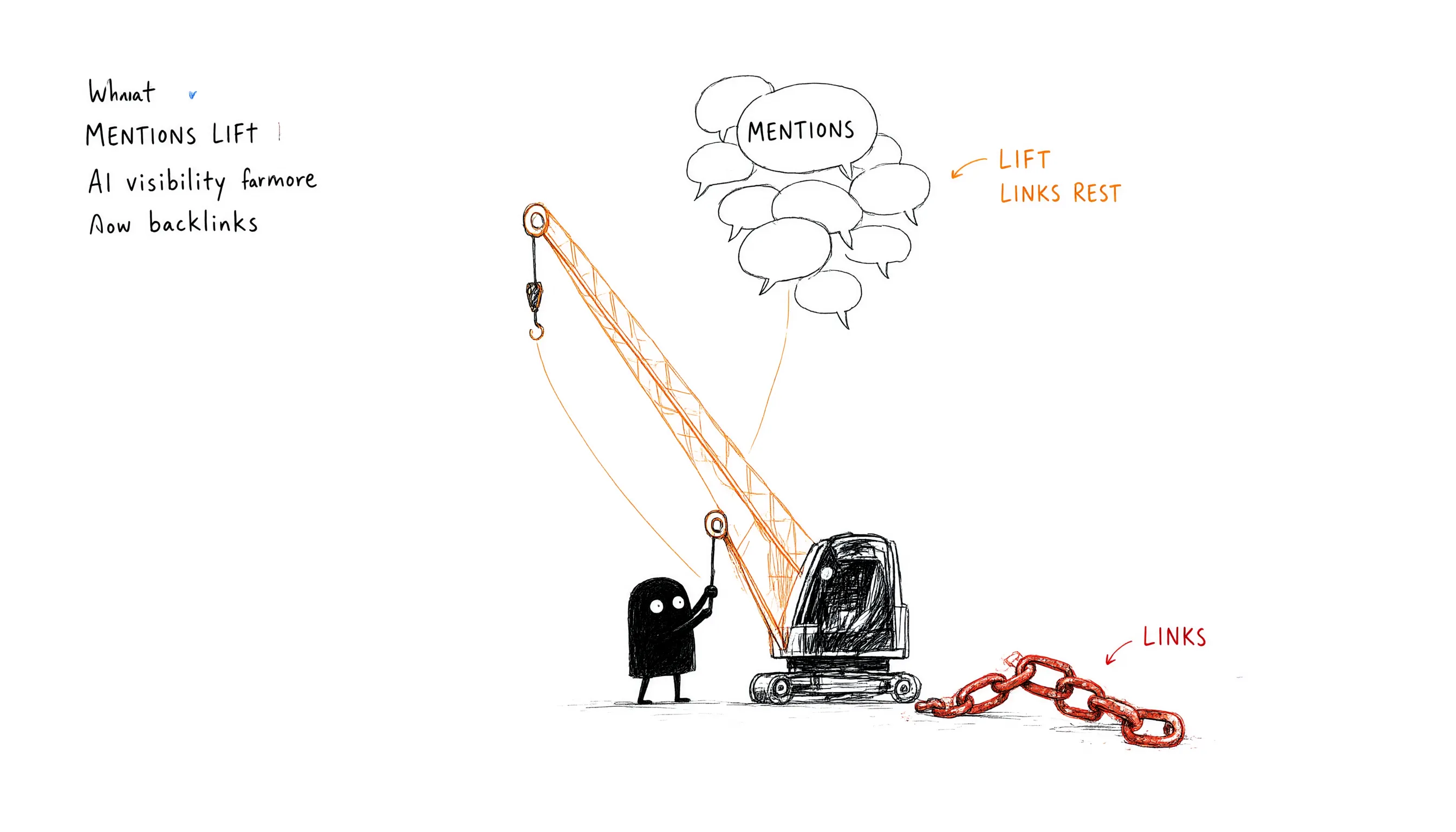
The distribution of citations is not gentle. The top quartile of brands by web mentions averages 169 AI Overview mentions, the next quartile averages 14, and the bottom half of brands by mentions barely register, averaging 0 to 3 (Ahrefs, via digitalapplied.com, 2026). This is a power-law market: the difference between being cited and being invisible is not 2x effort, it is clearing a threshold of earned presence.
That threshold explains why brand search volume predicts citations better than link volume. When people search for your brand, they already know it exists, which means your company cleared the awareness threshold. AI engines treat that as evidence the entity is real and relevant. For a young SaaS with low brand search volume, the implication is not despair, it is sequencing: build the earned-presence layer (mentions, community, publications, reviews) before expecting citation volume, because citations are downstream of awareness, not downstream of link equity.
What the Data Does Not Say#
Three caveats keep this analysis honest:
- Correlation is not causation. The studies measure association between brand signals and citation outcomes; the causal story, that engines prefer widely-known entities, is plausible and consistent with the tier data, but it is inference, not experiment.
- The studies lean on Google AI Overviews and aggregate LLM citation datasets. Platform behavior differs, and a niche B2B buyer’s queries may surface different source pools than consumer queries.
- Content still matters. Being known is not the same as being quotable. The freshest, best-structured pages win within every brand tier (freshness correlated 3.2x with citations in ConvertMate’s 80M-citation study). Brand presence determines whether you are in the pool; content quality determines whether you are picked.
The Budget Shift in Practice#
- Redirect a slice of link-acquisition budget to digital PR: product announcements, expert commentary, directory and review presence, and publication placements that use your brand name in context.
- Run community as an earned-media channel, not a traffic hack. Answers and threads that help people build the mentions and entity signals AI engines weight.
- Track brand search volume quarterly. It is the single strongest volume-based predictor of citation likelihood (0.334-0.392 across studies), and it is measurable with standard tools.
- Keep links, but reprice them. A link’s value now flows mostly through referral traffic and contextual brand mention, not through raw authority transfer to AI answers.
- Measure citations per engine separately from rankings. If the monthly report cannot show whether ChatGPT, Perplexity, Claude, or Gemini cited the brand this month, the report cannot see the effect of any of the shifts above.
How a Typical SaaS Team Should Reprice This#
Consider the standard mid-market SaaS allocation: most of the SEO budget on content production, a slice on link building through guest posts and directory submissions, and a smaller slice on digital PR. The correlation data suggests the link-building slice is the weakest spend for AI outcomes, but the fix is not to cut it and call the work done, because the same guest posts and directory placements can be restructured into mention plays: publish on channels that use the brand name in context, keep the author bio and the company description current, and ask for the mention even when the link is nofollowed, since the mention signal (0.664) is what the AI engines weight, not the link equity (Ahrefs, 75,000-brand study, 2026).
The second reprice is content. A technical comparison page that ranks well but reads like a spec sheet earns few citations, while the same content restructured answer-first, with named sources on every number and a refresh date visible, becomes quotable (freshness correlates 3.2x with citations in ConvertMate’s 80M-citation study, 2026). In practice this means the content calendar and the digital PR calendar should be one calendar: every launch, data point, or customer outcome is both a page to publish and a mention to pitch, and each feeds the other.
For a founder doing this without a team, the sequencing is simpler: publish genuinely useful technical content, answer real questions in two or three communities, and appear on one relevant podcast or publication per quarter. That rhythm is slow, but it builds the earned-presence layer the citation data actually rewards, which is more than raw link velocity can claim.
FAQ#
Are backlinks useless for AI visibility now? No, but they are the weakest traditional signal. Ahrefs’ 75,000-brand study puts backlinks at 0.218 correlation with AI Overview visibility, versus 0.664 for branded web mentions (ahrefs.com/blog/ai-overview-brand-correlation/, 2026). Links still drive referral traffic and can feed the branded-mention signal when they use your name in context; they just should not be the KPI for AI visibility.
What is the strongest predictor of AI citations? Across studies, brand search volume and branded mentions lead. ConvertMate’s 80M-citation study found brand search volume at 0.334, its strongest single variable; Ahrefs found branded web mentions at 0.664 and branded search volume at 0.392. Both beat backlinks at 0.218 (ConvertMate 2026; Ahrefs 2026).
How does a small SaaS with low brand awareness get cited? The tier data suggests sequencing, not shortcuts: earn presence first (mentions, community answers, reviews, publications), because the top quartile of brands by mentions averages 169 AI Overview mentions versus 14 for the next quartile (Ahrefs). Citations are downstream of awareness, and content freshness (3.2x for pages updated within 30 days) compounds once you are in the source pool (ConvertMate, 80M citations).
Should I stop building links entirely? No. Links still matter for referral traffic and for Google rankings, which still drive direct demand. The shift is about the AI-visibility budget: links correlate at 0.218 with AI citation outcomes while brand mentions correlate at 0.664, so a plan that spends equally on both is misallocated (Ahrefs, 2026).
Does domain authority still help in AI search? Weakly and declining. Ahrefs measured Domain Rating at 0.326, and Wellows reports domain authority correlation with AI citations falling to roughly 0.18 from 0.43 before 2024 (wellows.com, 2026). ConvertMate’s 80M-citation study even found a negative correlation between traditional authority metrics and citations. Authority is no longer the gate.
Bottom Line#
The correlation data across 75,000 brands and 80M+ citations reorders the SEO priority list: branded web mentions (0.664) beat branded anchors (0.527), which beat branded search volume (0.392), which beats domain rating (0.326), which beats backlinks (0.218). The gap between the top mention quartile and the next is more than tenfold, and the distribution is winner-takes-most (Ahrefs 2026; ConvertMate 2026). The strategic read is not that SEO died, it is that the AI era prices earned attention above link equity, and the brands that will be cited are the brands that are known, mentioned, current, and quotable. Budgets that follow the data will move money from link acquisition toward digital PR, community, and content freshness, and they will measure citations, not just rankings.
Sources: Ahrefs, “An Analysis of AI Overview Brand Visibility Factors (75K Brands Studied)” (ahrefs.com/blog/ai-overview-brand-correlation/, 2026); Digital Applied, “What Actually Gets You Cited in AI Search (2026 Data)” (digitalapplied.com/blog/ai-search-citation-ranking-factors-2026-data-study/, 2026); Machine Relations, “AI Search Citation Factors: What Determines Which Brands AI Engines Cite” (machinerelations.ai/research/ai-search-citation-factors-2026/, 2026); ConvertMate AI Visibility Study (80 million citations, 10,000+ domains, 2026); Wellows, “LLM Citation Trends That Matter in AI Search” (wellows.com/blog/llm-citation-trends-for-ai-search/, 2026); EShell AI visibility reporting practice (2026).
Related reading: AI Citation Source Index 2026: Where Answers Come From ↗ · Stale Content Loses AI Citations 3x Faster ↗ · SEO Rankings Do Not Drive AI Citations ↗ · Our services ↗