Google’s AI Overviews Just Dropped the “Show More” Button#
Two weeks ago I started noticing a new shape in Google results. On complex queries, the AI Overview no longer sat there as a compact box with a “Show more” button. It simply opened into a full answer, a long structured response that filled the first screen, and the ten blue links I was looking for had moved below it. It happened on enough searches that I checked whether Google had said anything. It had.
Google confirmed that for some queries, AI Overviews may dynamically expand to their full state, replacing the snippet with a full detailed response when its systems decide it is most useful (seroundtable.com/google-ai-overviews-push-ai-mode-responses, September 2026, retrieved September 9, 2026). Search Engine Land covered the same confirmation and noted the behavior pushes the core results down and gives an AI Mode type of experience inside the main Google interface (searchengineland.com/google-is-dynamically-expanding-ai-overviews-for-some-queries-486200, September 2026). This week Performance Marketing World reported the expansion is now rolling out more broadly and quoted marketers warning that it “is going to further impact organic traffic” (performancemarketingworld.com, September 9, 2026).
The short version: Google is removing the step between a snippet and a full AI answer. The queries that trigger it get an AI Mode-style response on the main results page, organic results move down, and the old assumptions about what a top ranking is worth stop applying to that share of searches. If your reporting still treats Google as a ranked list of links with a click-through rate, this is the moment to add a second layer of measurement. Here is what changed, what the existing data says about the impact, and what software companies should do this month.
What Changed, and How Google Describes It#
The mechanic is easy to miss because it looks like a layout tweak. It is not. Previously, AI Overviews had two states: a collapsed snippet and an expanded version you reached by clicking “Show more.” Google has begun auto-expanding some overviews into the full state. A Google spokesperson told Search Engine Roundtable: “For some queries, AI Overviews may dynamically expand for topics where our systems determine it’s most useful for people” (seroundtable.com, September 2026).
Three details in that sentence matter for anyone running organic search:
- It is dynamic and query-dependent. Google decides per query whether a full expansion helps. The observable effect, confirmed by Search Engine Land, is that the expanded answer pushes classic results further down the page (searchengineland.com, September 2026). For the queries that trigger it, the first screen is now owned by the answer, not by links.
- The “Show more” step is gone for those queries. The full answer is the default state, which means the extra click that used to signal intent (and gave publishers a moment of visibility before the fold) no longer exists.
- This is rolling out on top of AI Mode, which Google said in May 2026 had surpassed one billion monthly users a year after launch, with queries more than doubling every quarter (blog.google/products-and-platforms/products/search/search-io-2026, May 2026). The expansion into the main results page is a separate surface, but it serves the same product logic.
The reporting so far is careful: Google frames it as usefulness-driven, not as a blanket change. What marketers are seeing in the field, per Performance Marketing World’s September 9 report, is that the queries where Google decides expansion is useful include exactly the research-heavy, multi-part questions that used to produce the most valuable organic sessions (performancemarketingworld.com, 2026).
What the Existing Data Says About an AI Overview’s Effect#
The expansion makes a measured phenomenon bigger, which is why the earlier numbers are worth restating. When an AI Overview appears, the click economics of the page change:
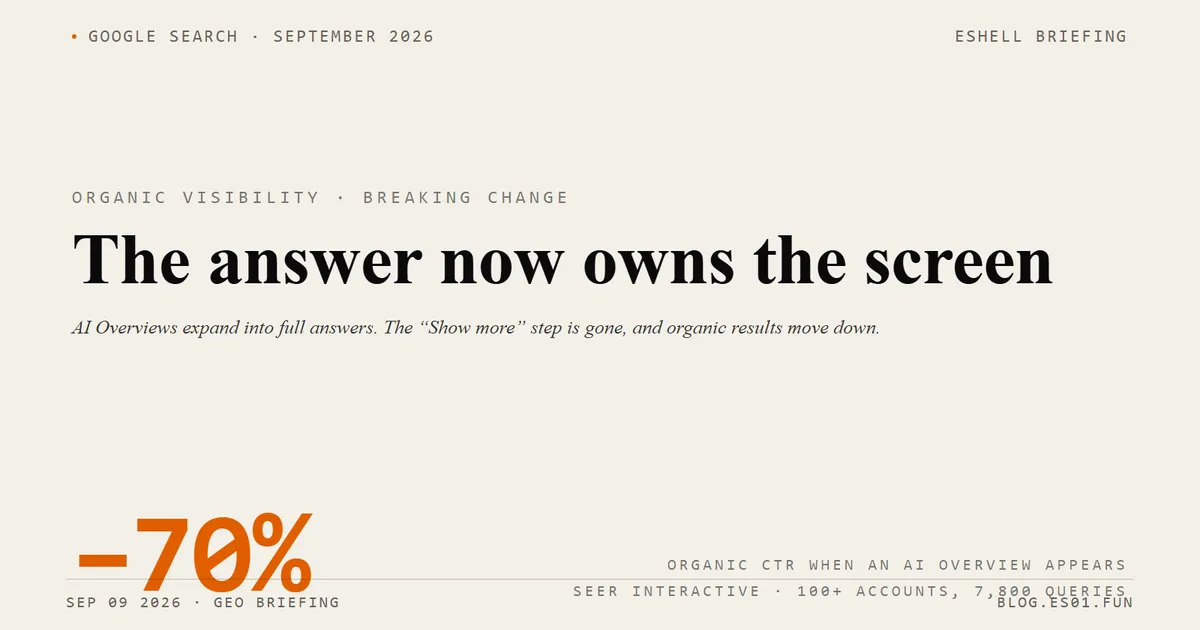
- Organic click-through rate drops by roughly 70% when an AI Overview is present, based on Seer Interactive’s tracking across 100+ client accounts and 7,800 queries (seerinteractive.com, research cited by Forbes, 2026; summarized at columnfivemedia.com, retrieved September 9, 2026).
- Link clicks inside the AI summary are rare. Pew Research Center found that in visits to pages with AI summaries, only about 1% included a click on a link within the summary itself (pewresearch.org/short-reads/2025/07/22, July 2025).
- The counterweight: when buyers do click, they click with intent. TrustRadius found 90% of higher-intent buyers clicked through to at least one cited source when they encountered AI Overviews during research (prnewswire.com, TrustRadius ninth annual Buyer Research Report, 2025; summarized at columnfivemedia.com).
The pattern these numbers describe is not “AI kills all traffic.” It is that the traffic a brand gets through Google is increasingly filtered by whether it is inside the answer, not beside it. The 70% CTR drop and the 1% in-summary click rate both point the same direction: for pages that are cited, influence is becoming measurable separately from clicks; for pages that are not cited, rankings alone are buying less and less attention.
Why This Hits Software Companies Differently#
For B2B software, the relevant fact is that the highest-intent commercial queries are precisely the kind AI Overviews and AI Mode handle best. Comparison questions, pricing questions, and “which tool should we pick” questions are structured, answerable, and common, which makes them candidates for dynamic expansion. And the citation layer under those answers does not follow the Google top 10. Only 38% of pages cited in Google AI Overviews rank in the top 10 organic results, and 36.7% of cited URLs do not rank in the top 100 at all, based on Ahrefs’ analysis of 863,000 keyword SERPs and 4 million AI Overview URLs (ahrefs.com/blog/ai-overview-citations-top-10/, March 2026).
Put the two findings together and the situation for a SaaS company is specific: your ranking can be healthy while your category’s answer cites a competitor’s comparison page, and with the full-state expansion that answer now occupies more of the screen than ever. Ranking and being cited have been diverging for a year, and the gap between them is exactly what this layout change makes visible. We documented the same divergence from the citation side in “SEO Rankings Don’t Drive AI Citations” and from the source side in “AI Citation Source Index 2026.”
There is a second effect that gets less attention: the credibility transfer. When a buyer reads a full AI answer and then does what 63% of B2B buyers do, which is search for the company on Google to verify it (Semrush survey of 622 US B2B professionals, semrush.com/blog/how-ai-shapes-b2b-buying, July 2026), the verification search now happens on a results page where other queries’ AI Overviews may crowd the first screen. The brand that is cited in the answer and consistent in the verification search wins both layers. The brand that only ranks well loses the first layer and gets less of the second.
The Audit You Can Run This Month#
- Separate “ranked” from “cited” in your reporting. Track which of your money keywords now trigger AI Overviews and which pages are cited inside those answers, monthly. If your report cannot answer “are we in the answer or just in the list,” it cannot tell you whether this change hurt you.
- Write for the answer, not just the click. Question-shaped headings, a direct answer in the first paragraph of each section, tables and lists that survive extraction, and every number traceable to a named source are what make a page citable. The GEO writing rules we published in “Technical SEO for SaaS” apply here with extra force because the answer now occupies more screen space.
- Audit your commercial pages for quotability. Pricing pages, comparison pages, and “best X for Y” pages are the ones AI Overviews reach for on buying-intent queries. If your pricing is an image, your comparison lives in a PDF, or your numbers carry no source, you are unquotable at exactly the moment the layout rewards quoting.
- Keep earning the mention layer. Brand presence and third-party mentions remain the strongest predictors of AI visibility, with branded mentions correlating at 0.664 against backlinks at 0.218 across 75,000 brands (Ahrefs, ahrefs.com/blog/ai-overview-brand-correlation/, 2026). The full-state expansion makes the mention layer more valuable, because answers that fill the screen draw from it.
- Measure influence separately from traffic. A cited page that receives few clicks is not a failure if the answer shapes the shortlist and the verification search happens later. Track appearances in AI Overviews and AI Mode per engine, and let sales log whether prospects mention AI research in the first call.
FAQ#
What exactly changed with Google AI Overviews? For some queries, Google now auto-expands AI Overviews into their full state instead of showing a snippet with a “Show more” button. The company confirmed the behavior is dynamic and usefulness-based (seroundtable.com, September 2026). Search Engine Land reports the expanded answers push classic results further down the page (searchengineland.com, September 2026).
Does this affect every search query? No. Google says expansion happens “for some queries” where its systems determine a full answer is most useful. The practical issue is that research-heavy, multi-part queries, the ones that previously drove valuable organic sessions, appear to be disproportionately affected per field reports (performancemarketingworld.com, September 9, 2026).
Is organic traffic dead? No, but it is being re-filtered. Seer Interactive measured roughly a 70% organic CTR decline when AI Overviews are present (seerinteractive.com, 2026), and Pew found only about 1% of visits to pages with AI summaries included a click on a link inside the summary (pewresearch.org, July 2025). Traffic still exists; it increasingly flows to sources cited inside answers rather than to the highest-ranking links.
Do rankings still matter for software companies? Rankings still drive direct traffic and verification searches, but they are no longer the gate to being cited. Only 38% of pages cited in Google AI Overviews rank in the top 10, and 36.7% of cited URLs do not rank in the top 100 (Ahrefs, March 2026). The layout change widens the gap between ranking and being seen.
What should I do first? Add an AI visibility layer to your monthly reporting: which money queries trigger AI Overviews, which pages are cited inside them, and how those pages compare with what ranks. Then make your pricing and comparison pages quotable, and keep the earned-presence loop running, because mentions remain the strongest predictor of citations (Ahrefs, 75,000 brands, 0.664 versus 0.218).
Bottom Line#
Google removed a step that used to sit between searchers and full AI answers. For the queries that trigger it, the results page now leads with a complete answer, and organic results move down, with Seer’s data showing roughly 70% lower organic CTR when an overview is present and Pew measuring about 1% of visits clicking links inside the summary (seerinteractive.com, 2026; pewresearch.org, July 2025). The durable response for software companies is not to chase the layout. It is to operate on both layers at once: be the source cited inside the answer, and be the company that verifies cleanly when the buyer searches for you afterward. Teams that measure citations alongside rankings, keep commercial pages quotable, and keep earning third-party mentions will hold up regardless of how much screen the answer takes.
Sources: Barry Schwartz, “Google AI Overviews Pushing Searchers Into AI Mode, Drops Show More Button” (seroundtable.com/google-ai-overviews-push-ai-mode-responses-41974.html, September 2026, retrieved September 9, 2026); “Google is dynamically expanding AI Overviews for some queries” (searchengineland.com/google-is-dynamically-expanding-ai-overviews-for-some-queries-486200, September 2026); “‘It is going to further impact organic traffic’: What Google’s dynamic AI Overviews expansion means for marketers” (performancemarketingworld.com, September 9, 2026); Google, “A new era for AI Search” (blog.google/products-and-platforms/products/search/search-io-2026/, May 2026); Seer Interactive AI Overviews research (seerinteractive.com, 2026, cited by Forbes; summarized at columnfivemedia.com, retrieved September 9, 2026); Pew Research Center, “Google users are less likely to click on links when an AI summary appears” (pewresearch.org, July 22, 2025); Ahrefs, “Update: 38% of AI Overview Citations Pull From The Top 10” (ahrefs.com, March 2026); Ahrefs AI Overview brand correlation study (75,000 brands, ahrefs.com, 2026); TrustRadius, ninth annual Buyer Research Report (prnewswire.com, 2025); Semrush, “How AI tools shape the B2B buying process” (semrush.com, July 2026).
Related reading: Why Reddit Citations Just Fell 86% in ChatGPT ↗ · Backlinks Are Now the Weakest AI Citation Signal ↗ · SEO Rankings Don’t Drive AI Citations ↗ · Our services ↗