SEO for SaaS Companies: The 2026 Playbook That Covers Three Engines#
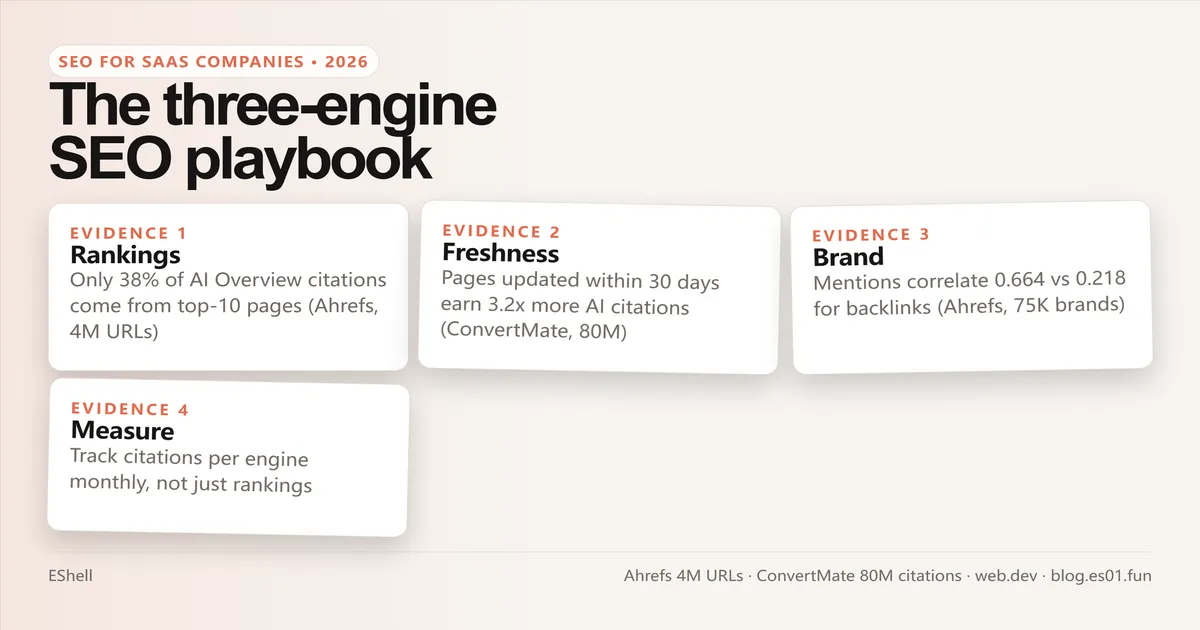
Only 38% of pages cited in Google AI Overviews also rank in the top 10 organic results, and 36.7% of cited URLs do not rank in the top 100 at all, based on Ahrefs’ analysis of 863,000 keyword SERPs and 4 million AI Overview URLs (ahrefs.com/blog/ai-overview-citations-top-10/, March 2026). For a SaaS company that sentence is the whole story of modern SEO: the rankings you can see in your dashboard and the citations that feed AI answers have decoupled, and a third surface, brand search and mentions, predicts AI visibility better than any link metric (Ahrefs, 75,000-brand study, 2026).
The short version: SEO for SaaS in 2026 is a three-engine game. Engine one is classic Google organic, still the biggest source of qualified search traffic. Engine two is AI answers in ChatGPT, Perplexity, Gemini, and AI Overviews, where freshness and quotability beat rankings. Engine three is brand presence, because branded mentions (0.664 correlation) and brand search volume (0.334-0.392) now predict AI citations far better than backlinks (0.218). This playbook walks through all three, what to build in each, and how to sequence the work on a small team.
Engine One: Google Organic Still Pays the Bills#
Traditional SEO is not dead, it is just no longer the whole game. Organic search remains the highest-intent traffic channel for most SaaS products, and the technical foundations have not changed: Google must be able to crawl and render your pages, and real users must be able to load them quickly.
The core checklist for a SaaS site:
- Crawlability and rendering. Every page that should rank must be reachable from internal links, must return 200 for its canonical URL, and must render its content without JavaScript-only text that crawlers cannot see.
- Core Web Vitals. Google’s official thresholds remain LCP under 2.5 seconds, INP under 200 milliseconds, and CLS under 0.1 (web.dev/vitals, official documentation). Marketing pages with heavy hero animations and third-party scripts routinely fail these; the fix is usually budget allocation, not a redesign.
- Index hygiene. Keep noindex off pages you want ranked, fix canonical drift, and keep the sitemap in sync with 200-status URLs. On Cloudflare Workers or similar edge stacks, a canonical pointing at a redirecting or extension-mismatched URL quietly kills indexing (this blog documented the fix pattern in its own crawl-index audit).
- Structured data. Product, software application, FAQ, and organization schema help engines map your entity. FAQ schema in particular correlates with roughly 40% higher citation weighting in ChatGPT (Profound data, summarized in 2026 platform citation analyses).
The trap on this engine is treating it as the only engine. Many SaaS teams spend a full year reaching page one for their money keywords, then discover AI answers do not cite page-one results anyway. Rankings matter, but they are no longer the gate.
Engine Two: AI Answers Run on Freshness and Quotability#
AI search engines evaluate sources differently from Google. An outdated fact in a generated answer is a direct quality failure for the model, so recency is weighted aggressively. The data:
- Pages untouched for more than three months are over 3x more likely to lose AI citations than recently refreshed pages, and more than 70% of cited pages were updated within the past 12 months (AirOps and Kevin Indig, “The 2026 State of AI Search,” airops.com, December 2025).
- Content updated within 30 days earns 3.2x more AI citations than older content, and traditional domain authority shows a negative correlation with citations (ConvertMate AI Visibility Study, 80 million citations, 10,000+ domains, 2026).
- About 60% of Google AI Overview citations come from URLs outside the organic top 20 (AirOps, 2025), and only 38% come from top-10 pages (Ahrefs, March 2026).
Quotability is the second property AI engines reward. Pages get cited when a model can lift a clean answer out of them: the answer near the top of the section, descriptive sequential headings, one idea per section, tables and lists that survive extraction, and every number traceable to a named source. Sequential headings and schema correlate with 2.8x higher citation rates in AirOps’ analysis. A pricing page or a “best tools” comparison written for humans only is, in AI terms, unquotable.
For SaaS content teams this means two operational changes: a refresh cadence (commercial pages quarterly, evergreen annually) and a quotability pass on every page (answer-first structure, sources on every data claim, FAQ blocks). Freshness is the ranking factor you fully control, and it compounds.
Engine Three: Brand Presence Predicts Citations Better Than Links#
The 2026 correlation data is uncomfortable for anyone whose agency pitch was built on link velocity. Across 75,000 brands, Ahrefs measured branded web mentions at 0.664 correlation with AI Overview visibility, branded anchor text at 0.527, and branded search volume at 0.392, versus 0.218 for backlinks (ahrefs.com/blog/ai-overview-brand-correlation/, 2026). ConvertMate’s 80M-citation study independently found brand search volume to be the strongest single predictor of LLM citations at 0.334. The mechanism is straightforward: AI engines were trained on the whole web, so they can observe which entities people actually search for and mention, and they reach for those entities when generating answers. Link graphs were Google’s proxy for reputation; AI engines do not need the proxy.
The distribution is winner-takes-most: the top 25% of brands by mention volume average 169 AI Overview mentions versus 14 for the next quartile (Ahrefs). Clearing that threshold requires earned presence, not link equity:
- Digital PR: product launches, expert commentary, data-backed announcements that get your brand name used in context.
- Community: genuine answers and contributions in the places your buyers ask questions. Community content is also a direct citation source, Reddit and developer forums remain heavily cited by Perplexity and AI Overviews (GEORaiser Q1 2026 cross-platform analysis).
- Review and listing presence: G2 and comparable platforms now function as mention sources that AI engines weight.
- Professional publishing: for B2B SaaS, LinkedIn articles and credible industry publications are climbing AI source rankings; LinkedIn went from rank 11 to rank 5 on ChatGPT between November 2025 and February 2026, with articles driving 50-66% of its citations (GEORaiser, Q1 2026).
Measurement: The Dashboard That Sees All Three Engines#
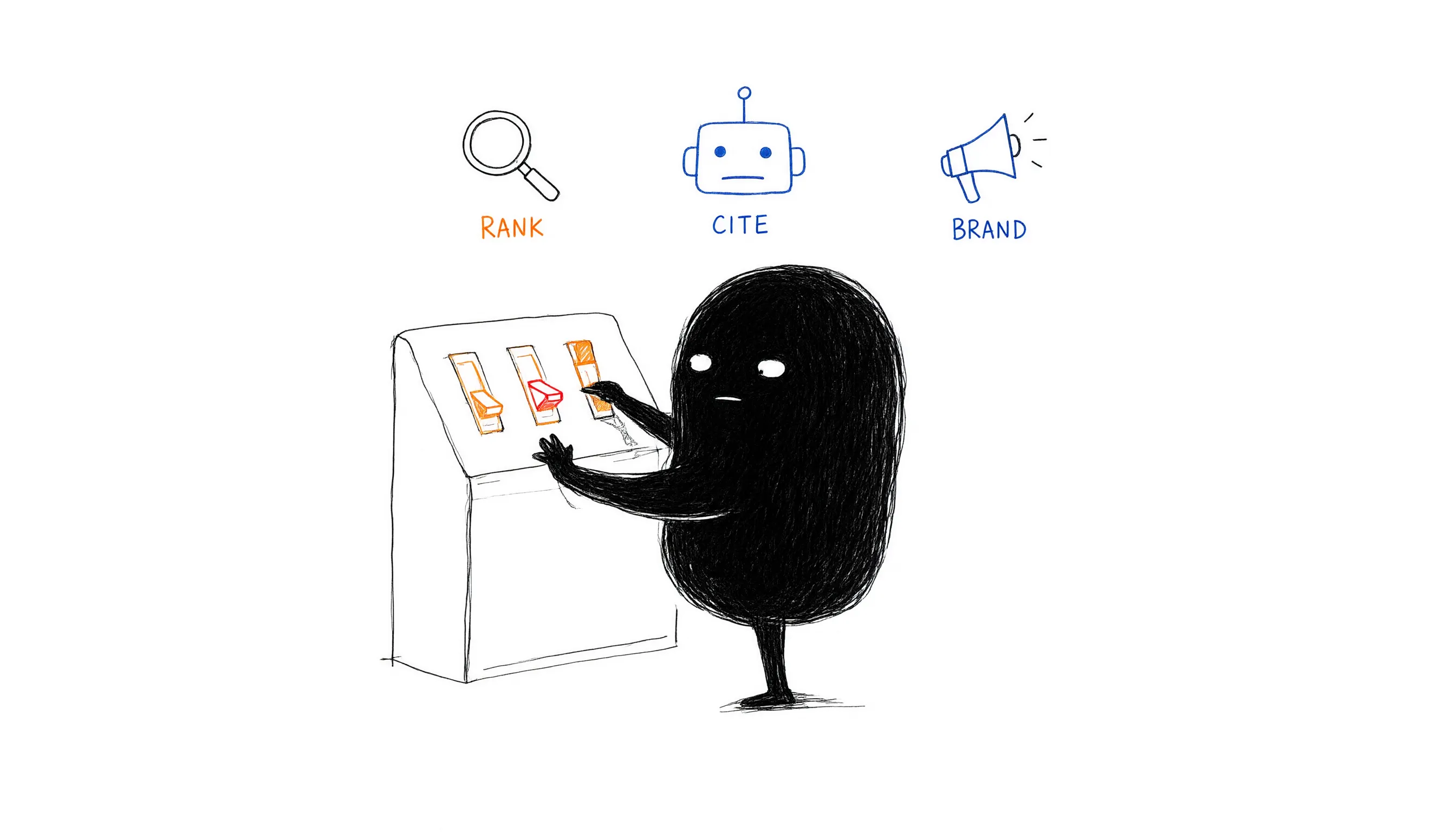
Most SaaS SEO reports still show keyword rankings and backlinks, which are the two metrics with the weakest connection to AI outcomes. A 2026 report needs three layers:
- Google: rankings, clicks, and indexed-page coverage for your money keywords.
- AI citations: whether your brand and pages appear inside ChatGPT, Perplexity, Claude, Gemini, and AI Overview answers, tracked per engine over time. This is a separate metric from rankings; pages hold rankings while losing citations, and the reverse.
- Brand: branded search volume quarterly and earned mentions by month. These are the leading indicators for engine three.
Without layer two, none of the other work is observable. A visibility audit that checks what each engine says about your brand, monthly, is the minimum instrumentation for a three-engine strategy.
Sequencing on a Small Team#
A three-engine plan sounds like three workstreams, but a small SaaS team should sequence, not parallelize:
- Month 1-2: fix the technical floor (crawlability, Core Web Vitals, schema, index hygiene) and instrument citation tracking so the work is measurable.
- Month 2-4: run the quotability and freshness pass on the pages that matter most, pricing, comparison, and top-of-funnel educational content, and set the refresh cadence.
- Month 4-6: start the earned-presence loop: two to four digital PR or community plays per month that put the brand name in context, plus one professional article per quarter.
- Ongoing: refresh on cadence, measure all three layers monthly, and let the citation layer tell you which content to double down on.
The order matters because the engines compound: technical soundness keeps you eligible, quotable content makes you citable, and brand presence decides whether the model reaches for you at all.
FAQ#
Does a SaaS company still need a blog for SEO in 2026? Yes, but the job description changed. Blog content feeds Google organic, and when written to be quotable (answer-first structure, sources on data, FAQ blocks, refresh cadence) it feeds AI answers directly. Content updated within 30 days earns 3.2x more AI citations than older content (ConvertMate, 80M citations), so the blog’s value now comes from the refresh loop, not just the publish event.
How long does SEO for SaaS take to show results? Google organic typically moves in quarters, and AI citations compound on the same cadence with one difference: freshness effects are visible faster. AirOps found pages older than three months lose citations at 3x the rate of refreshed pages (airops.com, December 2025), which means the downside of neglect is fast even when the upside of new content is slow.
Should we optimize for Google or for AI search? Both, but with different content. Rankings still drive the largest share of qualified direct traffic, and AI answers increasingly cite pages that do not rank in the top 10 at all (36.7% of cited URLs rank below 100, per Ahrefs’ 4M-URL study). Write money pages for ranking and quotability simultaneously, because the two now share more structure than they share rankings.
What is the biggest mistake SaaS teams make with AI visibility? Measuring it with SEO tools. If the report tracks keyword positions and backlinks but cannot show whether ChatGPT, Perplexity, or Gemini cited the brand this month, the team is optimizing blind on the surface where buyers form shortlists. The second mistake is publishing once and never refreshing, which the freshness data punishes at 3x (AirOps) to 3.2x (ConvertMate).
Do we need an agency to do this, or can a small team run it? A small team can run the technical floor and content freshness internally, since both are documented playbooks. The two places outside help pays for itself are the earned-presence loop (digital PR, community strategy, professional publishing) and citation measurement, because both require network and tooling that take months to build from scratch.
Bottom Line#
SEO for SaaS in 2026 is three engines, not one. Google organic still delivers the traffic, AI answers reward freshness and quotability over rankings, and brand presence has become the strongest predictor of whether AI cites you at all: 0.664 for branded mentions versus 0.218 for backlinks across 75,000 brands (Ahrefs, 2026). The teams that win are not the ones with the most links or the loudest launch days. They are the ones with clean technical foundations, a refresh loop on commercial content, a steady earned-presence rhythm, and a dashboard that measures all three engines monthly.
Sources: Ahrefs, “Update: 38% of AI Overview Citations Pull From The Top 10” (ahrefs.com/blog/ai-overview-citations-top-10/, March 2026); Ahrefs, “An Analysis of AI Overview Brand Visibility Factors (75K Brands Studied)” (ahrefs.com/blog/ai-overview-brand-correlation/, 2026); Google, “Web Vitals” (web.dev/vitals, official thresholds); AirOps and Kevin Indig, “The 2026 State of AI Search” (airops.com/report/the-2026-state-of-ai-search, December 2025); ConvertMate AI Visibility Study (80 million citations, 10,000+ domains, 2026); GEORaiser, “YouTube Overtakes Reddit as #1 AI Citation Source in 2026” (georaiser.com/blog/youtube-overtakes-reddit-ai-citations, Q1 2026 analysis, updated September 2026); EShell SEO and visibility practice (2026).
Related reading: Backlinks Are Now the Weakest AI Citation Signal ↗ · Technical SEO for SaaS: The 2026 Checklist ↗ · Stale Content Loses AI Citations 3x Faster ↗ · Our services ↗