B2B Email Outreach Agencies 2026: Real Costs and Red Flags
What B2B email outreach agencies do, what they actually charge in 2026, and the five questions that separate agencies with honest metrics from volume resellers.
B2B Email Outreach Agencies in 2026: What They Do, What They Cost, and How to Choose#
I have watched the same founder conversation happen for three years. They sent 400 cold emails by hand, got four replies and no calls, and now they are staring at agency websites showing prices from 10,000 a month for “the same service.” The gap looks like price gouging. It is not. It is the difference between a lead-generation product and an outreach operation, and the published prices in 2026 finally make that difference readable.
A B2B email outreach agency plans, sends, and reports on cold email campaigns for your company: it builds or sources a targeted list, verifies addresses, sets up deliverability infrastructure, writes the sequences, and reports replies and meetings with a defined metric. The market in 2026 runs from roughly 10,000+ for enterprise programs, with most serious engagements landing between 6,000 a month (outboundsystem.com/blog/how-much-does-a-cold-email-agency-cost, July 2026; leadium.com/blog/cold-email-marketing-agency, 2026). Setup fees of 3,000 are typical, and infrastructure that many proposals quietly exclude adds 2,000 a month on top (leadium.com, 2026).
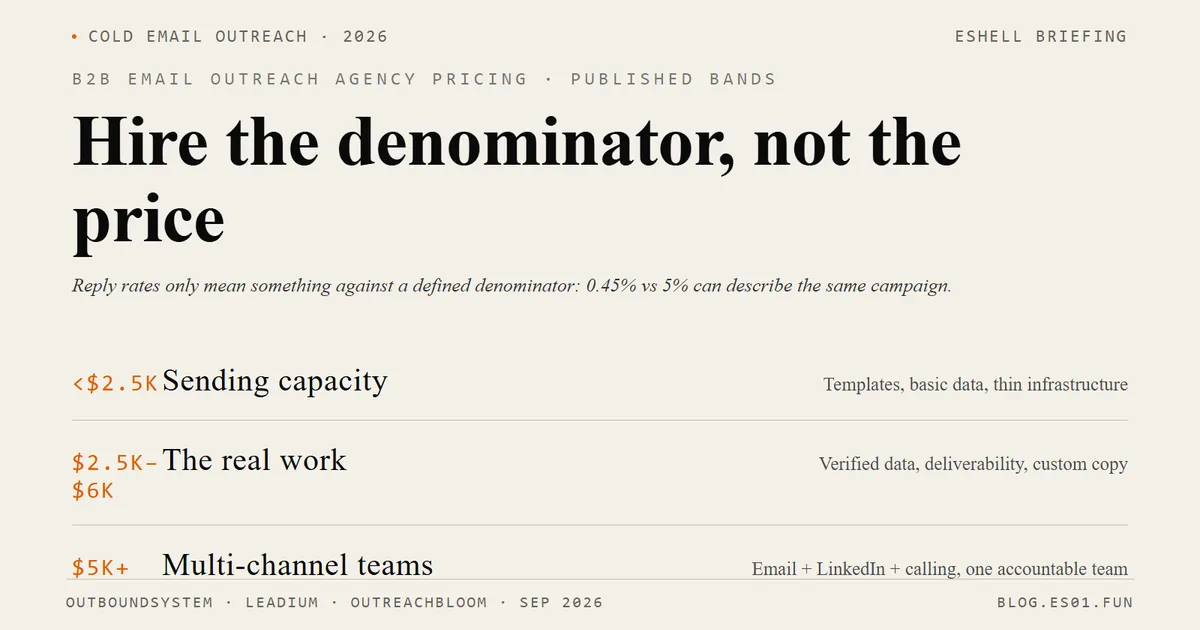
The short version: the price of a B2B email outreach agency is now published widely enough to map, and the map has three bands: under 2,500 to $6,000 is where custom copy, verified data, and deliverability infrastructure actually live; above that you are buying multi-channel SDR teams or enterprise volume. The number that matters more than price is the denominator an agency reports against. In 2026, with honest total-sends math producing reply rates around 0.45% while opener-based math claims 5%, an agency that will not tell you its denominator is an agency you cannot evaluate. Here is the pricing evidence, the metric test, and the questions that separate outreach operators from volume resellers.
What an Outreach Agency Actually Does#
Before comparing prices, it helps to name the workstreams, because agencies price different bundles of them:
- List building and verification. Sourcing contacts that fit an ICP and verifying addresses so bounce rates stay low. This is where the “20,000 emails a month” line gets misleading: list quality, not send volume, drives replies. Across Belkins’ 2025 campaigns of 7.5 million emails, smaller targeted campaigns of 50 recipients or fewer averaged 5.8% reply rates versus 2.1% for campaigns of 500+ recipients (belkins.io/blog/cold-email-response-rates, updated June 26, 2026, summarized at autobound.ai/blog/cold-email-guide-2026, retrieved September 9, 2026).
- Deliverability infrastructure. Authenticated sending domains you own, warm-up, inbox rotation, and spam-rate monitoring. Serious agencies put their standard in writing, such as spam under 0.10% with a kill-switch (leadium.com, 2026).
- Copy and personalization. Sequence writing and the signal-based personalization that separates modern outreach from templates. The 2026 benchmark data is blunt here: personalized campaigns average 18% reply rates versus 9% for template sends across 20 million emails (Woodpecker, 20M-email analysis, woodpecker.co, 2026).
- Sending and follow-up logic. Timing, follow-up cadence, and list rotation. Roughly 58% of all replies come from the first email in a campaign, with steps 2-4 contributing the other 42% (Instantly Cold Email Benchmark Report, instantly.ai, 2026), which means follow-up design is a real workstream, not an afterthought.
- Reporting. Replies, positive replies, meetings booked, and cost per meeting, measured against a defined denominator. This is the workstream that separates agencies from volume resellers, and it is the one most buyers forget to price.
The 2026 Price Map#
Pricing transparency improved sharply this year, partly because comparison pages now read prices off agency sites directly. OutreachBloom’s comparison table, with prices read from each vendor’s own site on August 18, 2026, lists: OutreachBloom at 5,000 a month, CIENCE at 5,000 setup plus 499 a month platform), SalesRoads at 397 a month per seat for LinkedIn outreach with $1,995 a month for cold email (outreachbloom.com/cold-email-agencies, retrieved September 9, 2026).
Cross-checked against agency cost guides and roundups published in 2026, the bands hold:
| Price band | What it typically includes | Sources (retrieved 2026-09-09) |
|---|---|---|
| 2,500/mo | Entry-level done-for-you sending, template-based copy, basic data sourcing, limited personalization, small-scale infrastructure | outboundsystem.com (July 2026); sequenzy.com (RevBoss from 2,500/mo) |
| 6,000/mo | Custom copy, verified or triple-verified data, deliverability infrastructure, dedicated strategist, proper reporting. The stated sweet spot for most B2B companies | outboundsystem.com (July 2026); leadium.com (6,000 retainers); outreachbloom.com (2,000-$8,000 for cold email campaigns) |
| 15,000/mo | Full-service and multi-channel programs: email plus LinkedIn and sometimes calling, enterprise volume | outreachbloom.com (Belkins from 5,000-5,000-5,000); leadium.com (full-service SDR 5,000 multi-channel) |
| Per-meeting models | 700 per qualified meeting, with the guarantee priced in | leadium.com (2026); outboundsystem.com (500/meeting typical) |
| Outside the retainer | Setup 3,000 one-time; infrastructure 2,000/mo (sending domains, inboxes, data, verification tools) often excluded | outboundsystem.com (July 2026); leadium.com (2026) |
Practitioner threads agree with the published bands. In r/b2bmarketing’s discussion of whether cold email agencies are worth 2,500 (typically 20,000 to 30,000 emails a month) with realistic full programs landing at 9,000 (reddit.com/r/b2bmarketing, 2026, retrieved September 9, 2026). The market is not as opaque as it felt two years ago, which is good news for buyers and bad news for agencies that used opacity as their margin.
The Metric Honesty Test#
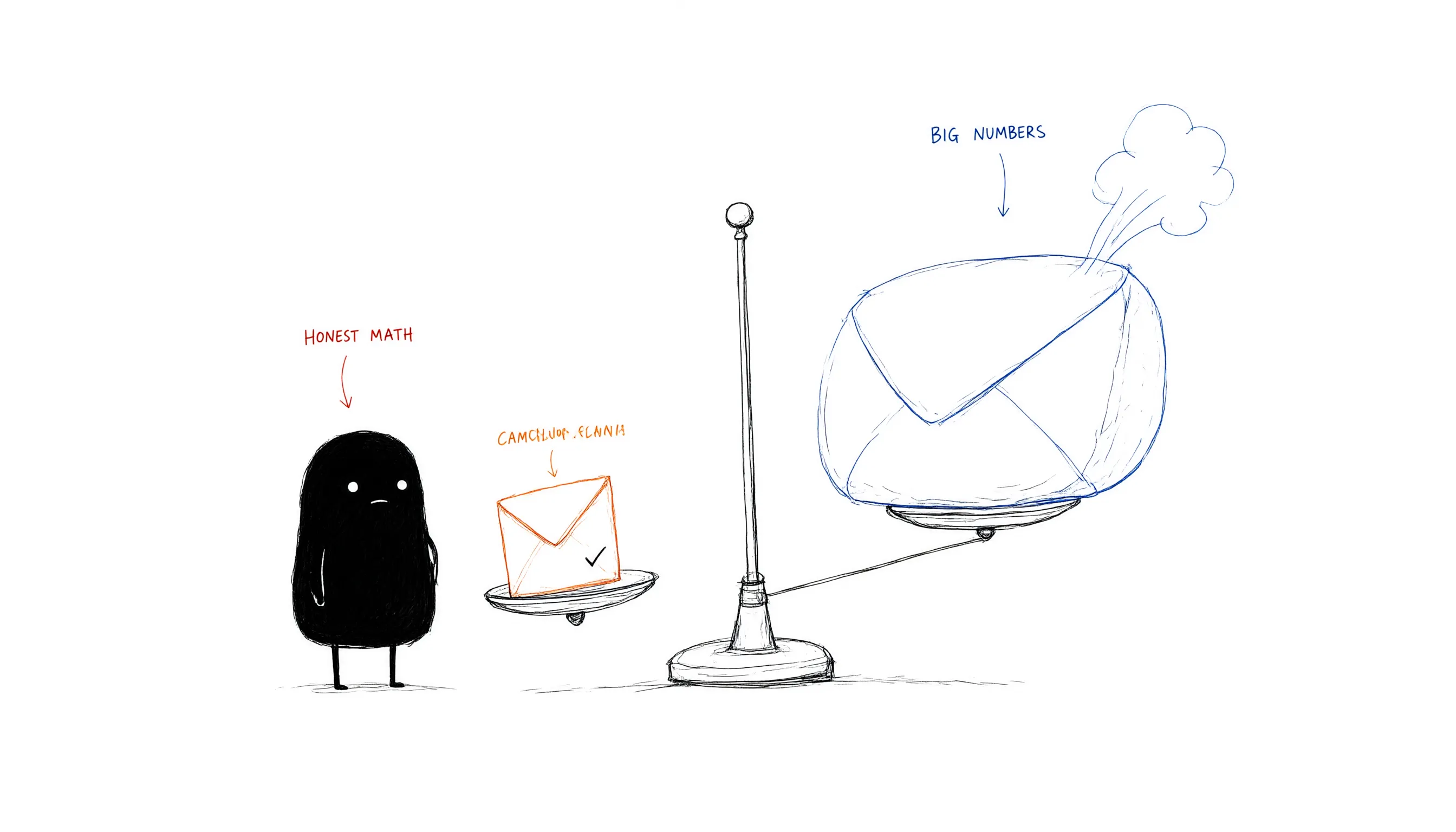
Here is the part that decides whether any price is worth paying. Cold email reply rates have no single number, because the denominator decides the result. Belkins’ 2026 study of 7.5 million emails reports its 2025 average reply rate as 0.45% against total emails sent, and explicitly notes that a 5% reply rate against openers and a 0.45% rate against total sends can describe the same campaign (belkins.io, updated June 26, 2026). Instantly’s platform-wide benchmark across billions of emails puts the average at 3.43% with top performers above 10% (instantly.ai/cold-email-benchmark-report-2026, 2026). Woodpecker’s 20-million-email analysis separates personalization tiers: 18% for personalized campaigns versus 9% for templates (woodpecker.co, 2026). None of these numbers is fake. They are answers to different questions.
When an agency quotes you a target reply rate, ask which denominator it means, and ask what it reports against in your monthly invoice. We wrote the full version of this test in “Cold Email Reply Rates 2026: The Denominator Test,” and it applies to agencies with extra force because an agency controls the measurement it reports. The agencies that publish honest denominators also tend to publish honest pricing, which is not a coincidence. The same discipline shows up in how they charge: Leadium notes that pay-per-meeting models run 700 per qualified meeting “with the guarantee priced in,” while agencies charging 200 a meeting typically book quantity over quality (leadium.com, 2026; outboundsystem.com, July 2026).
A related warning sign is volume framing. If the pitch leads with “we will send 100,000 emails a month,” the agency is selling sending capacity, and the benchmark data says volume works against you: larger campaigns average 2.1% reply rates versus 5.8% for campaigns of 50 or fewer recipients (Belkins data, 2026, summarized at autobound.ai). The agencies winning in 2026 sell smaller, better-targeted campaigns with signal-based personalization, which is the same conclusion the DIY data reaches in “Cold Email Split in Two.”
Red Flags and the Five Questions#
Beyond the metric test, the recurring red flags across the 2026 cost guides are consistent:
- Infrastructure excluded from the retainer. If domains, inboxes, data, and verification tools are billed separately at 2,000 a month, the “transparent” monthly price is not the monthly price (leadium.com, 2026).
- Commission or pay-per-meeting structures without qualification definitions. Commission on upper tiers is how Martal describes its model (outreachbloom.com, 2026); it can align incentives or invite quantity, depending on how “qualified” is defined and who defines it.
- No written deliverability standard. A serious agency will put spam rate under 0.10% and a kill-switch in writing (leadium.com, 2026). If the answer to “what happens when we get flagged” is vague, your domain is the collateral.
- Template economics. At 2,000 a month you are typically buying template-based emails and basic data sourcing (outboundsystem.com, July 2026). That can be fine as a test, but it is not the same product as the 6,000 tier with custom copy, AI-assisted personalization, triple-verified data, and a dedicated strategist.
- Results guarantees that guarantee the wrong thing. Nobody honest guarantees reply rates, because list and offer quality sit on your side. What a serious agency guarantees is process, volume, deliverability health, and reporting.
The five questions to ask before signing:
- What denominator do you report replies against, and what was your last 90 days of reply rate, positive-reply rate, and cost per meeting on that denominator?
- Is deliverability infrastructure in the monthly price, and do we own the sending domains?
- What is your written spam-rate standard and what happens if we hit it?
- Show me two current clients in my ICP with the same price tier, their campaign sizes, and their honest numbers. If the case studies are from 2023 or from a different industry, say so.
- What happens at month three if the trend line is flat, and what does the offboarding look like?
DIY, Tools, or Agency: Where the Lines Are#
The budget question has a defensible answer now. Under roughly 2,500 and $6,000 a month, an agency earns its fee if and only if it brings the three things tools do not: verified list strategy, deliverability operations, and honest reporting. Above that, you are buying multi-channel SDR capacity, email plus LinkedIn plus calling on one accountable team (leadium.com, 2026), and the comparison shifts from outreach to pipeline, which is the territory covered in “Marketing Agency for Software Companies: Pricing 2026.”
Whatever band you choose, the reporting standard should be identical. In our own practice we report replies and meetings against total emails sent, because the total-sends denominator is the only one a client can verify independently. An agency that objects to that denominator is an agency that was planning to use a flattering one.
FAQ#
How much does a B2B email outreach agency cost in 2026? Most professional B2B cold email services run 6,000 a month, with entry-level programs around 7,000 to 1,000 to 500 to 4,000 to $15,000 a month depending on vendor and scope (leadium.com; sequenzy.com).
Are cold email agencies worth it? They are worth it when the alternative is an unmanaged tool subscription and an unmeasured list. The agency’s value is verified list strategy, deliverability operations, and reporting you can audit. At 2,000 a month you are mostly buying sending capacity with template copy (outboundsystem.com, July 2026), which rarely beats disciplined DIY on a small targeted list.
What is a realistic reply rate to expect from an agency? It depends entirely on the denominator. Against total emails sent, Belkins measured a 0.45% average across 7.5 million emails in 2025, while opener-based math can claim 5% for the same campaign (belkins.io, June 2026). Platform benchmarks average 3.43% (Instantly, 2026), personalized campaigns average 18% versus 9% for templates (Woodpecker, 20M emails, 2026). Ask which denominator the agency reports before comparing its numbers to anyone else’s.
What is a fair price per meeting from a cold email agency? 700 per qualified meeting is the published range, with the qualification guarantee priced in (leadium.com, 2026; outboundsystem.com, July 2026). Rates of 200 a meeting usually indicate quantity over quality.
Should we hire an agency or do cold email in-house? Under about 2,500-4,000-$5,000+ for full-service SDR (leadium.com, 2026).
Bottom Line#
The B2B email outreach agency market in 2026 is priced openly enough to map: roughly 2,500 to 5,000 to 300 to $700 per qualified meeting on pay-per-meeting models (outboundsystem.com; leadium.com; outreachbloom.com; sequenzy.com, all retrieved September 9, 2026). The real differentiator is not the sticker price. It is the denominator. An agency that reports replies against total sends, publishes its deliverability standard, owns your domains, and shows current same-ICP case studies is worth the middle band. An agency that quotes a flattering percentage and sells volume is not worth any band. Buy the reporting discipline, and the price becomes the last thing you evaluate.
Sources: OutboundSystem, “Cold Email Agency Cost Per Month: 10K (2026 Guide)” (outboundsystem.com/blog/how-much-does-a-cold-email-agency-cost, July 24, 2026, retrieved September 9, 2026); Leadium, “Cold Email Marketing Agencies in 2026: Costs + Red Flags” (leadium.com/blog/cold-email-marketing-agency, 2026, retrieved September 9, 2026); OutreachBloom, “8 Best Cold Email Agencies for B2B Lead Gen (2026)” (outreachbloom.com/cold-email-agencies, vendor prices read August 18, 2026, retrieved September 9, 2026); Sequenzy, “21 Best B2B Lead Generation Services and Agencies (2026)” (sequenzy.com/blog/best-b2b-lead-generation-agencies, 2026); Cleverly, “How Much Does a B2B Lead Generation Agency Cost in 2026?” (cleverly.co, 2026); Belkins, “What are B2B Cold Email Response Rates? (2026 Study)” (belkins.io/blog/cold-email-response-rates, 7.5 million emails, updated June 26, 2026); Instantly, “Cold Email Benchmark Report 2026” (instantly.ai, 2026); Woodpecker, cold email statistics analysis (woodpecker.co, 20 million emails, 2026); Autobound, “Cold Email Guide 2026” (autobound.ai, aggregating Belkins campaign-size data, retrieved September 9, 2026); r/b2bmarketing pricing discussion (reddit.com, 2026); EShell outreach practice (600+ software clients, total-sends reporting).
Related reading: Cold Email Reply Rates 2026: The Denominator Test ↗ · Marketing Agency for Software Companies: Pricing 2026 ↗ · Best Cold Email Tools in 2026 ↗ · Our services ↗