AI Builds the Shortlist. Search Verifies It. Your Content Has to Win Both.#
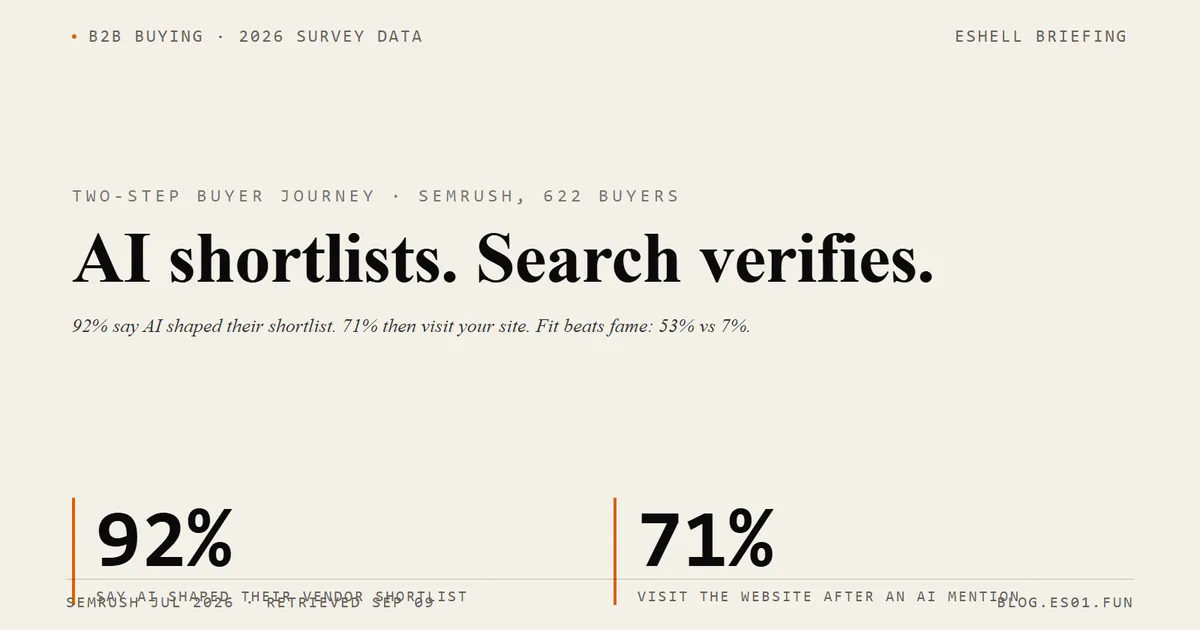
I keep a list of the questions founders ask me about AI search, and the most common one is still defensive: “How do I know my buyer is even using this stuff?” The 2026 survey data makes that question hard to keep asking. In Semrush’s survey of 622 US B2B professionals, 92% said AI has shaped their vendor shortlist, and 45% said it did so significantly (semrush.com/blog/how-ai-shapes-b2b-buying, published July 8, 2026, retrieved September 9, 2026). Among the 519 respondents who use AI for work, 66% regularly use it to research vendors and solutions, and another 29% do so occasionally. The shortlist your sales team never sees is being assembled in ChatGPT, Gemini, and Copilot.
But the second finding is the one most marketing plans miss. AI does not close the deal. It narrows the field, and then buyers verify. When an AI tool mentioned a vendor, 71% of buyers visited that vendor’s website, 63% searched for the company on Google, 46% compared it against alternatives, and 38% checked reviews on G2 or similar platforms (Semrush, July 2026). Only 14% asked colleagues. The buying motion is now two steps: AI decides who gets considered, and search-plus-website decides who survives the check.
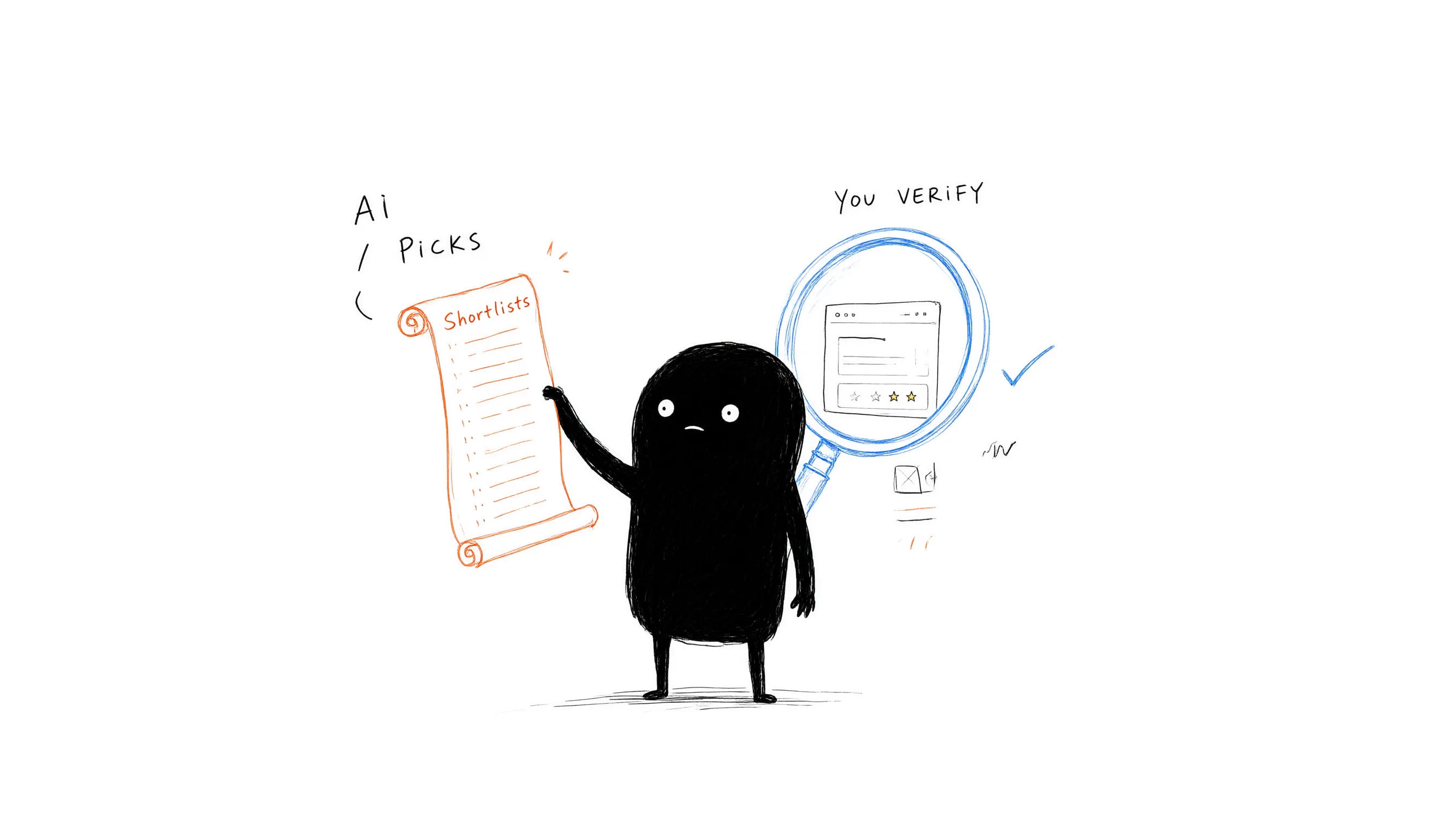
The short version: the B2B funnel is now a two-layer filter. Layer one is the AI answer, where 92% of buyers say their shortlist gets shaped and where use-case fit (53%) matters far more than brand recognition (7%). Layer two is verification, where 71% visit the vendor website, 63% search the company on Google, and 38% check review platforms. You can lose at either layer. The content that wins layer one is specific, structured, and matchable to a use case. The presence that wins layer two is consistent, verifiable, and reviewable. Most software companies are still building for one layer only.
The Two-Step Motion, In the Buyer’s Own Numbers#
Semrush’s methodology is worth stating because the sample is unusually decision-heavy: 622 valid US B2B professionals surveyed in March to April 2026, with 54% final decision-makers, 41% part of a decision-making group, and 24% at companies under 50 employees, 51% at companies under 200 (semrush.com, July 2026). The study is not a consumer convenience sample. These are the people who sign.
The sequencing data is the cleanest summary of the new motion:
- 41% of buyers now start with AI and validate via search. A further 35% start with search and turn to AI for synthesis or comparison, and 20% switch between both throughout (Semrush, July 2026). AI-first is already the largest single group, and it is the group growing fastest.
- AI appears at every stage, not just discovery: 72% use it during early research or scoping, 62% when actively comparing vendors, 48% to narrow the shortlist, and 45% to support the final decision (Semrush, July 2026). There is no stage left where a vendor can assume the buyer is looking at a ranked list of links.
- The influence is measurable at the bottom of the funnel, not just the top: 97% say AI has helped them discover new vendors, 92% say it shaped their shortlist, and 83% say it influenced their final vendor decision, with 32% reporting a major influence (Semrush, July 2026).
The budget reality behind those percentages: 43% of respondents typically evaluate purchases between 10,000 through AI research, and 42% evaluate purchases between 100,000. Agencies and service providers top the list of what buyers research via AI at 51%, with SaaS and software tools at 46% (Semrush, July 2026). For a software company selling to businesses, the channel that assembles the shortlist is now, in large part, an AI conversation your site is not part of.
The Bigger Studies Agree, and Add Scale#
Semrush is one vendor’s survey, so it is worth checking against larger, independent work before building a strategy on it. The direction matches.
G2’s research among 1,000+ B2B software buyers found 87% say AI chatbots are changing how they research software, and half now start their software buying journey in an AI chatbot rather than Google, a 71% jump versus G2’s prior survey four months earlier (learn.g2.com/ai-search-surging-for-b2b-buyers, 2026, summarized at columnfivemedia.com, retrieved September 9, 2026). The “half start in a chatbot” number is the one to sit with: for software specifically, the category where this blog’s readers operate, the starting line has already moved.
Forrester’s 2026 Buyers’ Journey Survey of 18,000 global business buyers found 94% used AI during their most recent purchase, up from 89%, and that AI answer engines now outrank vendor websites, sales reps, and product experts as the most meaningful vendor research source (forrester.com, January 2026, summarized at machinerelations.ai, retrieved September 9, 2026). Forrester also reported that 55% of buyers compare vendors in AI tools, 54% research products there, and 47% build internal business cases before any vendor contact, with companies reporting 10-40% traffic declines as research migrates into AI engines (machinerelations.ai, 2026). The buying cycle compressed from 11.3 months in 2024 to 10.1 months in 2025, driven by faster AI-enabled research (6sense, 2025, summarized at geisheker.com, retrieved September 9, 2026).
One nuance keeps the picture honest: buyers trust AI and then check it. The same Semrush survey found 75% fully or mostly trust AI vendor recommendations, yet almost all verify before committing (semrush.com, July 2026). TrustRadius found 90% of higher-intent buyers clicked through to at least one cited source when they encountered Google AI Overviews (prnewswire.com, 2025). Trust is not being replaced by AI. Trust is being routed through AI, and then re-earned on your website, your reviews, and your search results.
What Wins the First Layer: Fit Beats Familiarity#
The most strategically important finding in the Semrush survey is about attention inside an AI answer. When buyers see a brand mentioned in an AI response, they notice it when the vendor closely matches their specific use case (53%), when the description is clear and detailed (50%), and when it highlights clear benefits or outcomes (38%). Only 36% pay attention because the brand appears early or first, and just 7% notice a brand because they recognize the name (Semrush, July 2026).
Read that 7% twice, because it cuts both ways. For challenger products, it is the best news of the year: brand recognition barely registers at the AI layer, which means a lesser-known vendor with a precise, use-case-specific presence can outperform an incumbent that appears first. The mechanism shows up in buyer behavior too: 61% of buyers describe their specific use case or problem when researching vendors in AI, 56% ask for direct vendor comparisons, and 45% include constraints like budget or required features (Semrush, July 2026). The AI answer is a matching engine, and the vendors that get noticed are the ones whose published descriptions match the query’s shape.
The flip side is where incumbents should worry. Buyers also report what AI gets wrong: 33% say recommendations are too generic for their use case, 28% say responses lack depth or accuracy, 27% say they do not reflect real pricing or contract structures, and 27% flag credibility concerns (Semrush, July 2026). Every one of those complaints maps to a fixable content gap: use-case pages, documented outcomes, accurate pricing signals, and third-party coverage. The vendors that close those gaps are the ones that get picked at layer one.
What Wins the Second Layer: Verification Consistency#
Layer two is where the old rules come back, in a new order. After an AI mention, 71% of buyers visit the vendor’s website and 63% search the company on Google (Semrush, July 2026). That verification search is why brand presence still matters, and it explains the citation data we covered in “Backlinks Are Now the Weakest AI Citation Signal”: across 75,000 brands, branded web mentions correlate at 0.664 with AI Overview visibility while backlinks sit at 0.218 (Ahrefs, ahrefs.com/blog/ai-overview-brand-correlation/, 2026). The AI layer introduces the vendor; the verification layer confirms it, and confirmation runs on search results, reviews, pricing pages, and third-party mentions.
The operational consequence is that the two layers need different assets:
- Layer one (being in the answer): structured category and comparison content, use-case-specific pages, direct answers with sourced data, and freshness, since pages updated within 30 days earn 3.2x more AI citations than older content (ConvertMate, 80 million citations, 2026). This is the GEO writing discipline documented in “SEO for SaaS Companies: The 2026 Three-Engine Playbook.”
- Layer two (surviving verification): a fast, credible website, accurate and current pricing, a healthy review profile on the platforms your buyers check, and search results that confirm what the AI answer claimed. A mismatch between the answer and the verification step is how buyers get talked out of a purchase.
The second layer also has a sales implication. Only 39% of buyers say most stakeholders in their company actively use AI during vendor research, and 52% say adoption is mixed (Semrush, July 2026). The person who found you through AI may not be the final decision-maker, and their colleagues may have researched with different tools and seen different answers. Information asymmetry inside the buying committee is now a normal state. Marketing that produces one consistent description of the product, everywhere AI and search can read it, is what keeps all the committee members landing on the same story.
What This Changes in Practice#
- Rebuild your measurement around two layers. Track appearances in AI answers for your category and comparison queries (layer one), and track branded search volume, website visits after AI mentions, and review-platform activity (layer two). Sales should log whether prospects mention AI research in the first call; in our client reporting we treat that field as a leading indicator.
- Make the use case the unit of content, not the product. A page titled for a buying scenario with constraints (“project management tool for a 15-person agency that needs client billing”) will match how buyers prompt AI better than a feature-list page. The 61% who describe their specific use case are your content brief.
- Treat verification as part of the funnel. If your pricing page contradicts what review sites say, or your website is slow, or your third-party descriptions are outdated, the 63% who search for you after an AI mention are being handed a reason to leave.
- Do not assume incumbency transfers. The 7% brand-recognition finding means a category leader can be absent from AI answers and a challenger can win layer one with precision. But the 63% Google-verification step means the leader’s brand equity returns at layer two. Both layers must be staffed.
FAQ#
What percentage of B2B buyers use AI for vendor research? In Semrush’s survey of 622 US B2B professionals, 66% regularly use AI to research vendors and solutions and another 29% do so occasionally (semrush.com, July 2026). Forrester’s survey of 18,000 buyers found 94% used AI during their most recent purchase (forrester.com, January 2026).
Do B2B buyers trust AI recommendations? 75% of buyers fully or mostly trust AI vendor recommendations, but almost all verify before committing: 71% visit the vendor’s website, 63% search for the company on Google, and 38% check review platforms (Semrush, July 2026). Trust is routed through AI and then re-earned elsewhere.
Does brand recognition matter in AI answers? Surprisingly little at the answer layer: only 7% of buyers say they notice a vendor in an AI response because they recognize the name, versus 53% who notice vendors that closely match their specific use case (Semrush, July 2026). Brand equity returns at the verification layer, where 63% search for the company afterward.
Is SEO dead if AI builds the shortlist? No, but its role changed. Search is now the verification layer: 63% of buyers search for a company on Google after an AI mention, and 75% still use search engines as part of vendor research (Semrush, July 2026). The sequence changed, with 41% starting in AI and validating via search, but search did not disappear.
What should a software company do first? Audit both layers. For layer one, check whether your category and comparison queries mention you in ChatGPT, Gemini, and Perplexity. For layer two, check that your website, pricing, reviews, and search results match what the answer claims. Then build use-case-specific content, because fit is what gets noticed in AI responses (53%).
Bottom Line#
The B2B motion is now two steps: AI narrows the field, and search plus website verifies the survivors. The data is consistent across samples, from Semrush’s 622 decision-makers (92% say AI shaped their shortlist, 83% say it influenced the final decision) to G2’s finding that half of software buyers start their journey in a chatbot, to Forrester’s 18,000-buyer survey showing 94% used AI in their most recent purchase (semrush.com, July 2026; learn.g2.com, 2026; forrester.com, January 2026). Winning layer one takes use-case-specific, structured, current content, because fit beats familiarity in AI answers. Winning layer two takes consistency, because buyers verify what AI told them on your website, your reviews, and your search results. The teams that treat both layers as one funnel, and measure them separately, are the ones that will still be in the room when the committee forms.
Sources: Semrush (Margarita Loktionova), “How AI tools shape the B2B buying process: A survey of 600+ US business professionals” (semrush.com/blog/how-ai-shapes-b2b-buying/, 622 valid respondents, published July 8, 2026, retrieved September 9, 2026); G2, “AI Search Surging for B2B Buyers” (learn.g2.com/ai-search-surging-for-b2b-buyers, 2026, summarized at columnfivemedia.com, retrieved September 9, 2026); Forrester, 2026 Buyers’ Journey Survey (forrester.com/blogs/b2b_buyers_make_zero_click_buying_number_one/, January 2026; summarized at machinerelations.ai/research/b2b-ai-vendor-research-2026, retrieved September 9, 2026); 6sense buying-cycle data (2025, summarized at geisheker.com, retrieved September 9, 2026); Ahrefs AI Overview brand correlation study (75,000 brands, ahrefs.com/blog/ai-overview-brand-correlation/, 2026); ConvertMate AI Visibility Study (80 million citations, 2026); TrustRadius, ninth annual Buyer Research Report (prnewswire.com, 2025); EShell B2B visibility reporting practice (2026).
Related reading: Backlinks Are Now the Weakest AI Citation Signal ↗ · SEO for SaaS Companies: The 2026 Three-Engine Playbook ↗ · YouTube Overtook Reddit as AI Top Citation Source ↗ · Our services ↗